Contribution margin explained: formula, ratio & real world examples


Key takeaways
- Contribution margin is total revenue minus variable costs, measuring how much each sale contributes toward covering fixed costs and generating profit
- The three core formulas are: total contribution margin, contribution margin per unit, and contribution margin ratio (percentage)
- A healthy contribution margin for eCommerce in 2026 is a minimum of 20% after customer acquisition costs, with sustainable brands targeting 20–25%+
- Tracking contribution margin, not top-line revenue, reveals the true financial health of a product, channel, or business
- Understanding your break-even point (fixed costs / contribution margin per unit) tells you exactly how many units you need to sell before turning a profit
What is contribution margin?
Contribution margin is the amount of revenue remaining after subtracting all variable costs associated with producing and delivering a product or service. It represents the portion of each sale that "contributes" toward covering fixed costs and generating profit.
Unlike gross margin, which only deducts the cost of goods sold, contribution margin accounts for all variable costs, including fulfilment, transaction fees, and direct marketing spend. This makes it a more complete measure of per-unit profitability, especially for eCommerce and DTC businesses where ad spend is a significant variable cost.
At its simplest:
Contribution Margin = Revenue − Variable Costs
If a product sells for $100 and the total variable costs to produce, ship, and acquire that customer are $65, the contribution margin is $35. That $35 contributes toward covering fixed operating expenses like rent, salaries, and software.
Once your total contribution margin exceeds your fixed costs, the business is profitable. If it falls short, you are losing money on every sale, no matter how fast revenue grows.

Why DTC brands should obsess over contribution margin, not revenue
In the early 2020s, a flood of venture capital money entered the direct-to-consumer space. Brands like Warby Parker, Allbirds, Rent the Runway, and Casper were the poster children of the era.
It prompted a "growth at all costs" frenzy across the industry. VC firms invested over $5 billion into eCommerce at the peak in 2021. Much of this cash went into paid ads and inventory, with the aim of growing top-line revenue as quickly as possible.
Total VC investment into eCommerce ($USD B)
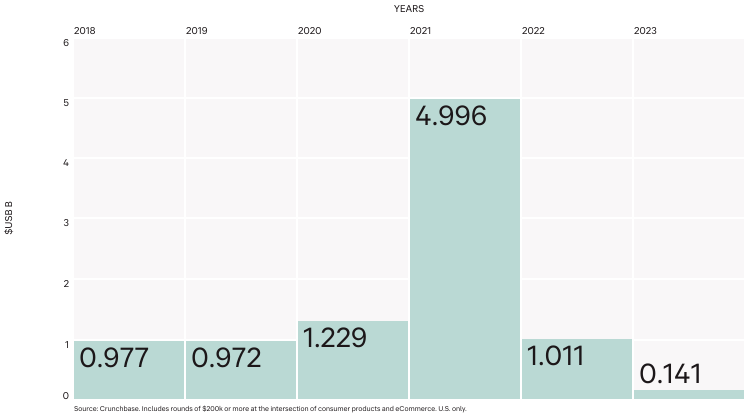
Founders made a bet that they would recoup short-term losses over the lifetime of a customer. Many lost that bet. Post-pandemic, VC interest collapsed, with just $140 million invested in 2023, a 97% drop from the peak.
The brands that survived shared two characteristics: profitable unit economics and careful cash flow management.
At Wayflyer, we have partnered with thousands of consumer brands as they have navigated these cycles. The pattern is unmistakable: the best operators obsess over contribution margin, not revenue.
Consider these real-world examples: a tale of two brands
Consider this tale of two brands: BizA and BizB. Both sell a similar product at the same price point of $100, but have very different contribution margins.
BizA sells more units than BizB and has a higher revenue figure as a result.
It even has a slightly better MER (Marketing Efficiency Ratio), meaning it's generating more sales per dollar of ad spend.
marketing efficiency ratio (MER) = sales / ad spend
If you were to consider units sold, revenue and marketing efficiency alone, you'd be forgiven for assuming BizA was the better performing business.
But let's dig into the contribution margin that each business generates to see if the picture changes.
BizA source their product from a premium supplier, so their product costs are higher than BizB, despite selling at the same price point.
BizA are poor at stock forecasting, so are frequently forced to turn to air freight for its quick delivery times, while BizB's shrewd inventory management means they can benefit from cheaper sea freight.
BizA are inefficient with their fulfilment processes, frequently putting products in oversized packaging, while BizB have opted for a 3PL provider whose operations run like clockwork.
As a result, BizA have a much lower contribution margin per unit of $12, compared to BizB at $35.
Now let's look at the extent to which each business covers their fixed operating expenses. Assuming each business has the exact same fixed OpEx of $100,000, BizA need to sell many more units than BizB to break even.
break-even point = fixed operating costs / contribution margin per unit
They actually fall short of this and make a $40,000 loss. In comparison, BizB need to sell far less to break even, and have beaten this target to generate a profit of $40,000.
Pulling contribution margin into this comparison paints a much different picture. The difference between the financial health of BizA and BizB is stark.
The best DTC businesses recognize how important the contribution margin metric is. True Classic, the golden child of eCommerce apparel and a Wayflyer customer, kept it top-of-mind on their journey to $200m+ in annual sales.
"I would say this is one of the most important lines in the P&L. And for businesses who are in hyper-growth mode, they need to understand how their activities maximise the contribution profit, not revenue and not any other metric in between."
How to calculate contribution margin: step by step
Calculating contribution margin requires accurately categorising your costs. Here is a step-by-step walkthrough.
Step 1: Start with net sales
Begin with your net selling price, not the number you see in your Shopify or Amazon dashboard. Strip out taxes, returns, and any shipping charges paid by the customer.
Net Sales = Total Sales Revenue − Taxes − Returns − Shipping Charges Collected
Step 2: Identify your variable costs
Variable costs change in direct proportion to the number of units sold. For eCommerce businesses, these typically include:
- Product cost (COGS): The cost of manufacturing and packaging each unit
- Freight cost: Getting the product from manufacturer to your warehouse or fulfilment centre
- Fulfilment cost: Picking, packing, and shipping to the end customer
- Transaction fees: Payment processing fees (Stripe, Shopify Payments, etc.)
- Direct ad spend: Performance marketing spend allocated per unit sold
Step 3: Subtract variable costs from net sales
Contribution Margin = Net Sales − Total Variable Costs
Step 4: Calculate your break-even point
Once you know your contribution margin per unit, calculate how many units you need to sell to cover all fixed costs:
Break-Even Point (units) = Total Fixed Costs / Contribution Margin Per Unit
If your fixed operating costs are $100,000/month and your contribution margin per unit is $14, you need to sell at least 7,143 units per month to break even.
Contribution margin calculator
Calculate your own contribution margin and break-even point below:
Contribution margin vs gross margin
Contribution margin and gross margin are related but distinct metrics. Confusing them can lead to overestimating per-unit profitability.
| Gross margin | Contribution margin | |
|---|---|---|
| Formula | Revenue − COGS | Revenue − All variable costs |
| Costs included | Cost of goods sold only (materials, manufacturing, packaging) | COGS + freight + fulfilment + transaction fees + direct ad spend |
| Costs excluded | Fulfilment, transaction fees, ad spend, all fixed costs | Fixed costs only (rent, payroll, software) |
| Best for | Evaluating production efficiency and supplier pricing | Evaluating true per-sale profitability and break-even analysis |
| Typical eCommerce range | 55–70% | 20–35% (after ad spend) |
When to use gross margin: Benchmarking production costs, comparing supplier quotes, evaluating whether your manufacturing is efficient.
When to use contribution margin: Making pricing decisions, evaluating whether to keep or drop a product, calculating break-even points, assessing whether your ad spend is sustainable.
For eCommerce businesses, contribution margin is almost always the more useful metric because it captures ad spend, which can represent 20–35% of revenue for DTC brands. A product can look highly profitable on a gross margin basis but lose money once you factor in customer acquisition. For a full breakdown of how both metrics flow through your financials, read our guide to eCommerce profit and loss statements.
Contribution margin benchmarks (2026)
What counts as a "good" contribution margin depends on your industry, business model, and growth stage. These benchmarks are based on 2026 data from analyses of 5,000+ eCommerce stores.
Gross margins by eCommerce vertical (CM1)
| Vertical | Typical gross margin (CM1) |
|---|---|
| Beauty & skincare | 80%+ |
| Health & fitness | ~50% |
| Fashion & apparel | 55–65% |
| Home goods & furniture | ~45% |
| Food & beverage | 35–50% |
| Electronics & gadgets | 25–40% |
Most stores maintain gross profit margins between 55–70%, with 60–65% considered optimal for sustainable growth.
Contribution margin after ad spend (CM3)
The more meaningful benchmark for DTC brands is CM3: contribution margin after customer acquisition costs. Based on 2026 industry data:
- Minimum healthy CM3: 20%
- Sustainable growth target: 20–25%+
- Best-in-class DTC operators: 25–35%
- Median DTC net profit margin: 3–10%
Customer acquisition costs have increased 40–60% since 2021, and ad spend now typically consumes 20–35% of DTC revenue. This means contribution margin management is more important than ever; the gap between gross margin and true contribution margin has widened considerably.
How to improve your contribution margin
There are five primary levers for improving contribution margin. The most effective operators work on all five simultaneously.
1. Reduce product costs (COGS)
- Negotiate volume discounts with suppliers
- Consolidate SKUs to increase product order quantities
- Source alternative materials without sacrificing quality
- Move manufacturing closer to your largest customer base to reduce landed costs
2. Optimise freight and fulfilment
- Use sea freight over air freight wherever lead times allow (can cut freight costs by 60–80%)
- Right-size packaging to avoid dimensional weight surcharges
- Negotiate fulfilment rates based on volume commitments
- Consider 3PL providers with warehouses near your customer concentration
3. Improve pricing strategy
- Test price increases, as many DTC brands underprice relative to perceived value
- Introduce tiered pricing or bundles that increase average order value
- Reduce discounting frequency; train customers to buy at full price
4. Lower customer acquisition costs
- Diversify beyond Meta/Google; organic, referral, and email channels have near-zero variable cost
- Improve landing page conversion rates to reduce cost per acquisition
- Target higher-LTV customer segments rather than optimising for volume
- Invest in retention to increase customer lifetime value (a repeat purchase has zero acquisition cost)
5. Minimise returns and refunds
- Improve product photography and descriptions to set accurate expectations
- Implement sizing guides and virtual try-on tools
- Address quality control issues at the source
Frequently asked questions
What is contribution margin in simple words?
Contribution margin is the money left over from a sale after you subtract all the variable costs of making and delivering that product. It is the amount that "contributes" toward paying your fixed business expenses like rent and salaries. Once your total contribution margin exceeds your fixed costs, the rest is profit.
How do you calculate the contribution margin?
Subtract your total variable costs from your total net sales revenue. The formula is: Contribution Margin = Net Sales Revenue minus Total Variable Costs. Variable costs include product costs, freight, fulfilment, transaction fees, and direct ad spend. You can calculate it as a total figure, per unit, or as a percentage (ratio) of revenue.
Is contribution margin the same as gross profit?
No. Gross profit only subtracts the cost of goods sold (COGS) from revenue. Contribution margin subtracts all variable costs, including fulfilment, transaction fees, and ad spend. Contribution margin gives a more complete picture of per-sale profitability because it captures expenses that gross profit ignores.
Is 30% contribution margin good?
A 30% contribution margin is generally considered strong, especially for eCommerce and DTC businesses where customer acquisition costs are significant. In 2026, a healthy contribution margin after ad spend (CM3) is a minimum of 20%, with sustainable brands targeting 20–25% or higher. A 30% CM puts you in the best-in-class range for most verticals.
What is a good contribution margin for eCommerce?
For eCommerce businesses in 2026, a good contribution margin after all variable costs (including ad spend) is 20% or above. Best-in-class DTC operators achieve 25–35%. Gross margins (before ad spend) typically range from 55–70% across most eCommerce verticals, with beauty and skincare brands achieving 80% or more.
What is the difference between contribution margin and net profit?
Contribution margin is revenue minus variable costs only. Net profit is revenue minus all costs, both variable and fixed (including rent, payroll, software, and taxes). Contribution margin tells you whether each sale is individually profitable. Net profit tells you whether the entire business is profitable after all expenses.
What costs are included in contribution margin?
Contribution margin includes all variable costs that change with the number of units sold. For eCommerce businesses, this typically means: cost of goods sold (manufacturing and packaging), inbound freight, fulfilment (pick, pack, and ship), payment processing and transaction fees, and direct performance marketing ad spend. Fixed costs like rent, payroll, and software subscriptions are excluded.