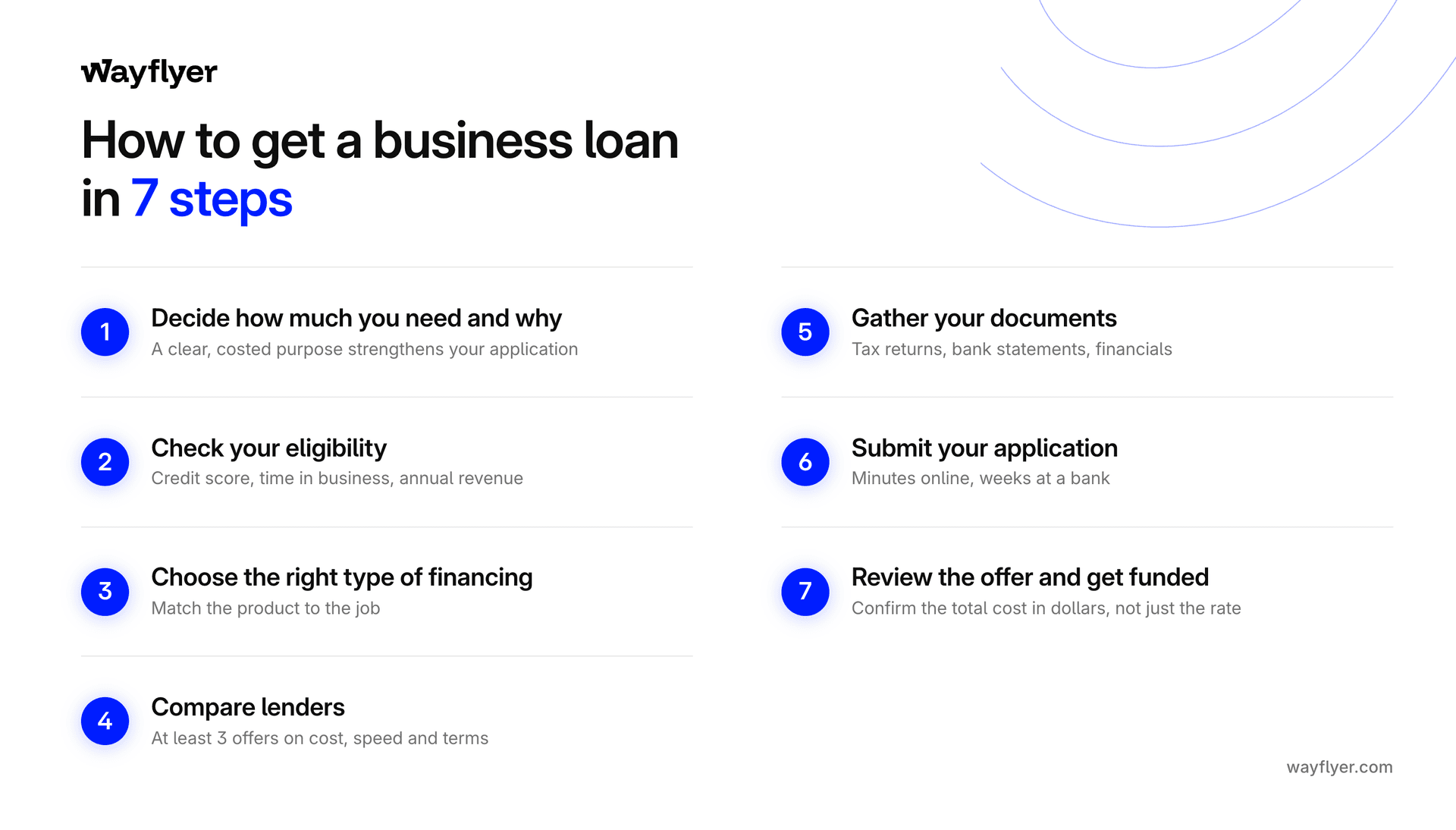
To get a business loan, you decide how much you need, check your eligibility, choose the right type of financing, compare lenders, gather your documents, submit your application and review the offer. Banks and SBA lenders offer the lowest rates but take weeks or months to fund. Online and revenue-based lenders can approve and fund you in as little as 24 hours. Your credit score, time in business and annual revenue determine which routes are open to you.
Key takeaways
Most lenders assess 4 things: credit score, time in business, annual revenue and cash flow
Banks typically want a personal FICO of ~680+, 2+ years in business and $100k+ in annual revenue; online lenders approve from ~500–600
Bank and SBA loans take several weeks to a few months to fund; online and revenue-based lenders can fund in 24 hours to a few days
Loan amounts range from a few thousand dollars to several million, depending on lender type and your financials
Bad credit or limited trading history narrows your options but doesn't close them; secured loans, revenue-based financing and merchant cash advances weigh recent sales over credit history
How do business loans work?
A business loan gives you a lump sum of capital that you repay over time, plus interest or fees. The amount you borrow is the principal. The cost of borrowing is expressed as an interest rate (usually APR) or, with some newer financing models, a single flat fee. The term is how long you have to repay, anywhere from 3 months to 25 years depending on the product.
Repayments are usually fixed monthly installments. Some products work differently: a line of credit lets you draw and repay flexibly, paying interest only on what you use, while revenue-based financing ties repayments to your sales, so you pay more in strong months and less in slow ones.
Lenders price your loan on risk. Stronger credit, longer trading history and healthier revenue mean lower rates and larger amounts. That's why the first real step in getting a business loan is understanding how a lender will see you.
How to get a business loan in 7 steps
Here's the full process, from working out what you need to getting the money into your account.
Step 1: Decide how much you need and why
Lenders will ask what the money is for, so have a specific answer: inventory, equipment, marketing, hiring, refinancing or buying another business. The use case shapes which product fits. Equipment purchases suit equipment financing, where the asset secures the loan. Inventory and marketing spend suit shorter-term products like lines of credit or revenue-based financing, because the capital pays for itself within months.
Borrow what the use case justifies, not the maximum you're offered. A clear, costed purpose also strengthens your application.
Step 2: Check your eligibility
Before you apply anywhere, know your numbers. Pull your personal credit score (and business credit score if you have one), confirm your time in business and calculate your trailing 12-month revenue. These 3 figures determine which lenders will realistically approve you, and checking first saves you from hard credit inquiries that go nowhere. It's worth the homework: in the Federal Reserve's 2026 Small Business Credit Survey, only 42% of applicants received the full amount of financing they requested.
As a rule of thumb: FICO 680+, 2+ years trading and $100k+ annual revenue opens up banks. FICO 650+ opens up most SBA lenders. Below that, look at online lenders, secured products or revenue-based financing, which weighs your recent sales performance more heavily than your credit history.
Step 3: Choose the right type of financing
Match the product to the job. Term loans suit large one-off investments. Lines of credit suit working capital swings. SBA loans suit borrowers who qualify and can wait. Revenue-based financing suits fast-growing businesses that need capital quickly without giving up equity. The types of business loans section below compares all 7 main options.
Step 4: Compare lenders
For any given product, costs and terms vary widely between lenders. Compare at least 3 offers on APR (or total cost of capital), repayment schedule, fees, funding speed and whether a personal guarantee or collateral is required. The cheapest headline rate isn't always the cheapest loan once origination fees and prepayment penalties are counted.
Weigh speed against cost honestly. A bank loan at a lower rate is the right call if you can wait 6 weeks. If the opportunity disappears in 2 weeks, a faster, slightly more expensive option can be worth far more than the difference in cost.
Step 5: Gather your documents
Requirements vary by lender, but expect to provide most of the following: business and personal tax returns (2 years), recent bank statements (3–6 months), financial statements (P&L and balance sheet), legal and ownership documents (formation documents, EIN, licenses) and, for startups and SBA applications, a business plan with financial projections.
Online and revenue-based lenders are lighter-touch. Many connect directly to your bank account, accounting software or sales platforms and skip most of the paperwork.
Step 6: Submit your application
Apply to your shortlist. Banks and SBA lenders involve in-person or detailed written applications and underwriting that takes weeks. Online lenders use automated underwriting; applications take minutes and decisions arrive within hours or days. Be strategic about hard credit inquiries: FICO's rate-shopping protection only groups mortgage, auto and student loan inquiries, so multiple business loan applications that pull your personal credit can each count separately. Use lenders that offer soft-pull prequalification where you can, and keep any hard-pull applications to your genuine shortlist.
Step 7: Review the offer and get funded
Before you sign, confirm the total repayment amount in dollars, not just the rate. Check for origination fees, prepayment penalties, personal guarantee requirements and what happens if you miss a payment. If anything is unclear, ask the lender to walk you through a full repayment schedule. Once you accept, funds typically arrive within 1–3 business days for online lenders, or at closing for banks and SBA loans.
What are the requirements for a business loan?
Business loan requirements come down to 4 core factors, with thresholds that vary sharply by lender type.
Requirement
Banks
SBA loans
Online / fintech lenders
Personal credit score
~680+
~650+
~500–600+ (some no minimum)
Time in business
2+ years
2+ years (some programs less)
6–12 months
Annual revenue
$100k–$250k+
$100k+ typical
$36k–$100k+
Collateral / guarantee
Often both
Personal guarantee required; collateral for larger loans
Usually unsecured; personal guarantee common
Documentation
Extensive
Extensive + business plan
Light; often connects to your bank data
A few notes on how lenders read these:
Credit score. For small businesses, your personal FICO matters more than your business credit score, because most lenders require a personal guarantee. Traditional banks typically look for 680+, while many online lenders approve from around 600. The SBA sets no universal minimum; individual SBA lenders do, and most want to see 650–680.
Time in business. 2 years is the standard bank threshold because it proves you've survived a full business cycle. Newer businesses aren't locked out; they just skip to online lenders, secured products or startup-specific programs.
Revenue and cash flow. Lenders want your monthly cash flow to comfortably cover the repayment. A common benchmark is a debt service coverage ratio of 1.25x, meaning $1.25 of cash flow for every $1 of debt payment; most SBA lenders use 1.25x as their floor.
Collateral and guarantees. Secured loans (backed by equipment, inventory, property or receivables) get better rates and higher approval odds. Unsecured business loans skip the collateral but lean harder on your credit and revenue, and almost always require a personal guarantee.
What are the main types of business loans?
Each product below fits a different job. The links go to deeper guides where we have them.
Term loan. A lump sum repaid in fixed installments over 1–10 years. Best for large, planned investments like expansion or refurbishment.
SBA loan. A bank loan partially guaranteed by the US Small Business Administration, with capped rates and terms up to 25 years. The flagship 7(a) program lends up to $5mn, and since July 2026 borrowers can combine 7(a) and 504 loans for up to $10mn in SBA-backed financing. Best for established businesses that qualify and can wait 30–90 days for funding.
Business line of credit. A revolving credit limit you draw on as needed, paying interest only on what you use. Best for managing cash flow gaps and seasonal swings.
Revenue-based financing. Capital advanced against your future sales, repaid as a share of revenue or on a schedule tied to your performance, for a single flat fee rather than compounding interest. Best for growing consumer brands and online businesses that need capital fast without giving up equity. How revenue-based financing works →
Invoice financing. An advance (typically 80–90%) against your unpaid B2B invoices. Best for businesses with long payment terms and reliable customers. See how it compares to factoring.
Merchant cash advance (MCA). A lump sum repaid as a fixed percentage of daily card sales. Fast and accessible with weak credit, but usually the most expensive option; compare the effective APR carefully.
Equipment financing. A loan or lease where the equipment itself is the collateral. Best for vehicles, machinery and hardware, often covering 80–100% of the purchase price.
You have 3 broad routes, and the right one depends on how you trade off cost, speed and eligibility.
Banks
SBA lenders & credit unions
Online & fintech lenders
Typical cost
Lowest rates
Low, capped rates
Higher rates or flat fees
Speed to funding
2–8 weeks
30–90 days
24 hours–1 week
Eligibility bar
Highest
High, but more flexible than banks
Most accessible
Loan sizes
Up to several million
Up to $5mn (7(a) program)
~$5k up to $20mn depending on lender
Best for
Established businesses with strong credit that can wait
Qualifying businesses that want the lowest long-term cost
Fast funding, newer businesses, credit flexibility
Banks offer the best pricing and the deepest relationships. If you have strong financials and time on your side, start there. Smaller community banks are worth a look too: in the Fed's latest survey, small banks fully approved 57% of applicants, more than any other lender type.
SBA lenders and credit unions offer near-bank pricing with a slightly lower bar, because the government guarantee reduces the lender's risk. The trade-off is paperwork and time.
Online and fintech lenders compete on speed and accessibility. Automated underwriting based on your live business data means decisions in hours rather than weeks, and borrowers are voting with their feet: the share of applicants using online fintech lenders has grown from 17% to 29% over the last 5 years, per the same Fed survey. If you need capital quickly or don't fit a bank's criteria, revenue-based financing from a provider like Wayflyer can fund from $5k up to $20mn in as little as 24 hours, for a single transparent fee and no equity given up.
These routes complement each other. Plenty of businesses hold a low-cost bank term loan for long-term investments and use faster financing for time-sensitive opportunities like inventory buys ahead of peak season. For a broader comparison of the options, see our small business loans hub.
How do you get a business loan with bad credit or no revenue?
You can still get funded with bad credit or a brand-new business. Your options narrow and your cost of capital rises, but 4 routes stay open.
Secured loans. Offering collateral (equipment, inventory, property or a cash deposit) offsets a weak credit score. Approval odds rise and rates fall because the lender's downside is covered.
Revenue-based financing. If your sales are strong but your credit history isn't, revenue-based lenders assess your recent performance data rather than your FICO score. Consistent monthly revenue matters more than what happened 3 years ago.
Merchant cash advances. MCAs approve applicants with scores as low as ~500 because repayment comes straight out of daily card sales. Treat them as a last resort at this end of the market and calculate the effective APR before signing.
Cosigners and guarantors. A creditworthy cosigner lets the lender underwrite their credit profile alongside yours. It's a serious ask, since they become fully liable if you default, so put the agreement in writing.
For startups with no revenue at all, business loans are genuinely hard to get; lenders have no cash flow to underwrite. Realistic alternatives include SBA microloans (up to $50k, designed for new businesses), business credit cards, equipment financing (the asset is the security), personal loans used for business, and grants. Once you have 6+ months of consistent sales, revenue-based financing and online term loans open up.
How long does it take to get a business loan?
Funding speed varies more than any other factor between lender types.
Lender type
Decision
Funds in your account
Online / revenue-based lenders
Same day–3 days
As little as 24 hours–1 week
Banks
1–4 weeks
2–8 weeks total
SBA loans
2–6 weeks
30–90 days total
The difference comes down to underwriting. Banks and SBA lenders review documents manually. Online and revenue-based lenders plug into your bank account and sales data and underwrite algorithmically, which is how a Wayflyer customer can apply, get a decision and receive funds in as little as 24 hours.
Match the route to your deadline. If your funding need is 3 months away, the slower, cheaper route wins. If your supplier needs a deposit this week, it doesn't.
How much can you borrow and what will it cost?
Business loan amounts range from about $5k (microloans) to $5mn+ (SBA 7(a) and bank loans), with online and revenue-based lenders typically funding between $5k and $20mn depending on your revenue. Most lenders cap borrowing at what your cash flow can service, commonly around 10–30% of annual revenue for unsecured products.
As a worked example: a $50,000 term loan at 10% APR over 5 years costs roughly $1,060 per month, or about $63,700 in total repayments. Shorten the term to 3 years and the payment rises to about $1,613/month, but total cost falls to about $58,100. Run your own numbers with our business loan calculator before you apply, so you can judge any offer against what your cash flow supports.
FAQs
How do you qualify for a business loan?
Lenders assess your credit score, time in business, annual revenue and cash flow; some also require collateral or a personal guarantee. Banks and SBA loans set the strictest bar (FICO ~650–680+, 2+ years trading, $100k+ revenue). Online and revenue-based lenders weigh recent sales performance more heavily than credit history.
What credit score do you need for a business loan?
Traditional banks generally want a personal FICO of ~680+, SBA lenders ~650+, and many online lenders approve from ~500–600. Revenue-based financing providers prioritize your sales performance over your score, which makes them a practical route if your credit history is thin or damaged.
Can a new LLC or startup get a loan?
Yes, though options narrow. A new LLC has no trading history to underwrite, so banks will usually decline. New businesses typically use SBA microloans, business credit cards, equipment financing or secured loans, then move to revenue-based financing or online term loans once they have around 6 months of consistent sales.
How much can you borrow with a business loan?
Amounts range from a few thousand dollars to several million, depending on lender type, your revenue and your creditworthiness. Unsecured borrowing is commonly capped around 10–30% of annual revenue. Wayflyer, for example, funds businesses from $5k up to $20mn based on sales performance.
How long does it take to get a business loan?
Banks take 2–8 weeks from application to funding, and SBA loans 30–90 days. Online and revenue-based lenders can approve and fund in as little as 24 hours to a few days, because they underwrite from your live banking and sales data rather than manual document review.
What documents do you need for a business loan?
Commonly: 2 years of business and personal tax returns, 3–6 months of bank statements, financial statements (P&L and balance sheet), legal and ownership documents, and a business plan with projections for startup or SBA applications. Online lenders often replace most of this by connecting directly to your bank and sales accounts.
What is the monthly payment on a $50,000 business loan?
It depends on the rate and term. As a rough example, $50,000 at 10% APR over 5 years is about $1,060/month (roughly $63,700 total). A shorter term or higher rate raises the monthly payment. Use a business loan calculator to model your own numbers before applying.
Is it hard to get a $100,000 business loan?
Not especially for an established business with solid revenue and credit; a $100k unsecured loan typically needs around $300k–$1mn in annual revenue and a FICO of 650+. Startups face a much higher bar. At $1mn+, lenders expect strong financials, collateral or a personal guarantee, and usually 2+ years of trading history.
Flexible funding built for growing brands
Wayflyer provides fast, flexible financing from $5k to $20mn, in as little as 24 hours, with no personal guarantee and no equity. Repayments flex with your revenue.