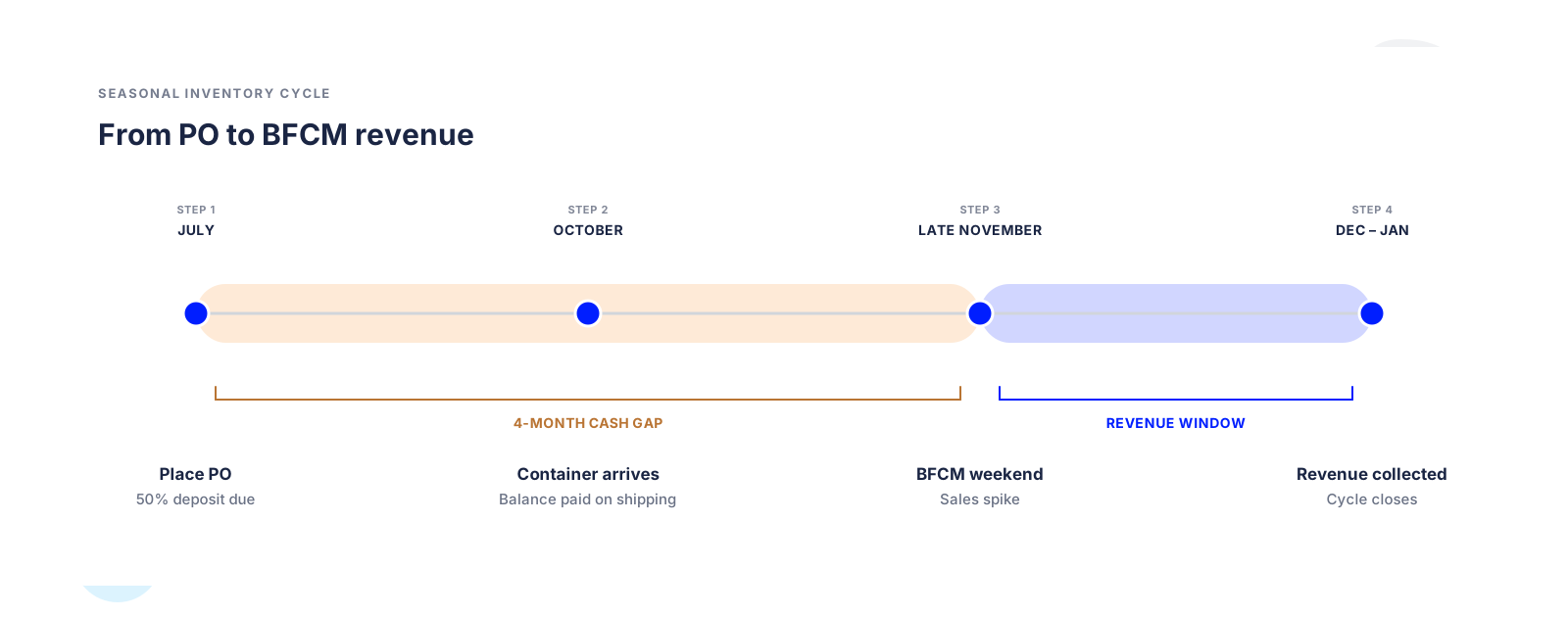
You're placing your BFCM 2026 purchase order in July. Your supplier wants 50% upfront and the balance on shipping. The container lands in October. Your sales hit in late November. That's a four-month gap between writing the cheque and seeing the revenue, and it's the gap most seasonal eCommerce brands underestimate. Inventory financing exists to close it. This guide compares the five seasonal inventory financing options consumer brands actually use (revenue-based financing, inventory lines of credit, short-term inventory loans, SBA Seasonal CAPLines, and purchase order financing) and walks through which fits which type of business.
Finance
Harry Bray28 Apr 2026
What is seasonal inventory financing?
Seasonal inventory financing is short-term funding that lets a business buy inventory ahead of a peak sales period and repay the lender from the revenue that peak generates. The inventory itself usually serves as collateral, and repayment is structured around the seasonal cycle rather than a fixed monthly schedule.
For consumer brands, the seasonal cash-flow problem is mechanical, not strategic. BFCM and Q4 typically deliver a meaningful share of annual revenue. The inventory that fuels them needs to be paid for months earlier. Shopify merchants alone generated $14.6 billion in sales over the BFCM 2025 weekend, up 27% from the year before. A brand doing 30% of its annual volume across that four-day window has to fund 30% of its annual COGS in July and August, when sales are at their lowest.
Prime Day creates the same squeeze for Amazon FBA sellers, who ship into FBA warehouses three to four weeks before the event. Summer-peak categories (swimwear, outdoor, garden) face the inverse, placing winter POs to land for spring. Gifting brands stack two cycles a year: Mother's Day plus Q4. In every case, the cash you need is locked into inventory you haven't sold yet.
How does inventory financing work?
Inventory financing is asset-based lending where the inventory you're buying, or already hold, secures the loan. The lender values the stock, advances a percentage of that value, and is repaid as you sell through. If you default, they have a claim on the inventory. Advance rates run from 50% to 80% of inventory value, depending on category and how easy the goods are to liquidate. Apparel and consumer electronics sit at the higher end. Slow-moving SKUs and perishables sit lower. Lenders require regular reporting on stock levels, sell-through, and aging, particularly as the facility gets larger.
Repayment structures vary. Inventory loans use fixed monthly payments. Lines of credit are repaid as you draw down and refill. Revenue-based financing ties repayment to sell-through, which is the most natural fit for seasonal eCommerce because payments scale with revenue rather than calendar dates.
How does an inventory loan compare to an inventory line of credit?
An inventory loan is a lump sum drawn at one time and repaid on a fixed schedule. An inventory line of credit is a revolving facility you draw against repeatedly, paying interest only on the outstanding balance.
Inventory loans suit one-shot inventory buys: a single container, a single seasonal PO, a planned launch. You know what you need, you draw it, you pay it back. Inventory lines of credit suit brands with rolling reorder cycles or multiple seasonal peaks across the year. You can fund a Q4 PO, repay through December and January, then draw again for the spring buy without reapplying. The trade-off is that lines of credit require more reporting, more covenants, and a stronger trading history to qualify for in the first place.
What's the difference between ABL and ABF?
Asset-based lending (ABL) and asset-based finance (ABF) are often used interchangeably, but they describe different things. ABL is the underwriting approach: a loan secured by specific business assets (inventory, receivables, equipment) where the borrowing base is tied to the value of those assets. ABF is the broader asset class that includes ABL plus factoring, equipment finance, and structured receivables facilities. For a seasonal eCommerce brand, ABL is the product you're applying for. ABF is the umbrella it sits under.
What are the 5 ways to finance seasonal inventory?
Five financing structures dominate seasonal inventory funding for consumer brands. They differ across speed, ticket size, cost, collateral, and how repayment is structured.
Revenue-based financing
Revenue-based financing (RBF) advances capital against future revenue. The lender takes a fixed fee, not a compounding interest rate, and is repaid as a percentage of your daily or weekly sales until the agreed amount is settled. There's no equity dilution and no fixed monthly payment, which is why RBF has become the default seasonal inventory option for DTC and Amazon brands. Repayment scales with the revenue the inventory generates: a strong BFCM clears the facility faster, a slower one stretches repayment over more weeks. A fixed-payment loan demands the same instalment in February as it did in November. RBF doesn't.
Read more about how revenue-based financing works for consumer brands.
Inventory line of credit
An inventory line of credit is a revolving facility from a bank or specialist asset-based lender, sized to a borrowing base of inventory and receivables. You draw what you need, pay interest only on the outstanding balance, and the line refills as you repay. Pricing is competitive (typically base rate plus a margin), but the bar is high. Banks generally want £10mn+ in revenue, audited financials, two to three years of trading, and ongoing borrowing-base reporting. For brands that clear that bar, an inventory line of credit is often the cheapest option in the market.
Short-term inventory loans
A short-term inventory loan is a lump-sum facility tied to a specific inventory buy and repaid over six to eighteen months on a fixed schedule. Approval takes one to three weeks and the underwriting bar is lower than a bank line. The trade-off is cost (APRs commonly land between 8% and 50%+ depending on lender type) and structure: fixed monthly payments don't flex with sell-through, so a slow Q4 still demands the same January payment. These loans suit brands that need a one-shot facility for a single seasonal PO with predictable enough sell-through to service the schedule.
SBA Seasonal CAPLine
The SBA Seasonal CAPLine is a US government-backed line of credit specifically for US businesses with a documented seasonal pattern. Loan amounts go up to $5 million, with terms up to 10 years, and the SBA guarantees up to 75% of facilities above $150,000. Pricing is competitive (typically prime plus 3% to 6.5%, depending on loan size) and proceeds can be used for seasonal inventory and accounts receivable.
The catch is timing and eligibility. Most lenders require at least 12 months of trading and a documented seasonal pattern, and typically also want two years of operating history and a personal credit score in the high 600s or above. Closing typically takes 60 to 90 days because of the documentation involved, which rules out this option for any brand financing this year's BFCM PO in July. CAPLines work as an annual planning tool, applied for in February to fund a July buy, not as a reactive option. Full programme details are on SBA.gov.
Purchase order financing
Purchase order (PO) financing funds the production of goods against a confirmed customer purchase order. The lender pays your supplier directly, the goods ship to your customer, and you repay when the customer pays the invoice. It's a wholesale-channel product, not a DTC one: there has to be a confirmed PO from a creditworthy buyer underwriting the deal. Brands with retail or marketplace channels (Target, Costco, Amazon Vendor) use PO financing to take orders bigger than their working capital would otherwise allow. Pure DTC brands rarely qualify because there's no third-party PO for the lender to underwrite.
Which option is best for your seasonal eCommerce business?
There's no universally correct answer: fit depends on revenue scale, channel mix, and how seasonal the business actually is. The shortcuts below cover the most common profiles.
Shopify DTC under £10mn GMV. Revenue-based financing, almost always. You won't qualify for a bank line at this scale, an SBA CAPLine takes longer to close than your cycle allows, and a fixed-payment loan punishes you in slower months. RBF gives you eCommerce working capital sized to actual sales data.
Amazon FBA seller. RBF if your seller account history is clean. PO financing rarely fits because there's no third-party PO. Inventory loans work for a known shipment, but watch the fixed payment schedule against Amazon's payout cycle.
BFCM-heavy gifting brand. RBF or a short-term inventory loan, depending on size. If 50%+ of annual revenue lands in November and December, fixed monthly payments through Q1 and Q2 are painful. At £20mn+ with strong financials, an inventory line of credit becomes cheaper.
Summer-peak swimwear or outdoor brand. Same logic, inverted. The PO lands in October for a March-to-July sell-through. RBF flexes naturally; fixed-payment loans don't.
Multi-brand portfolio operator. Inventory line of credit if you qualify: a single facility across brands beats separate loans. RBF tops up individual brands during their peaks. PO financing covers the wholesale channel.
For a comparison of all available financing structures, see how to choose the right eCommerce financing option.
What is the most appropriate facility to finance seasonal inventory purchases?
For consumer brands today, the most appropriate facility to finance seasonal inventory is revenue-based financing: it advances capital in 24 to 48 hours, ties repayment to actual sell-through, and avoids the fixed monthly payments that squeeze cash flow during slower post-peak months.
The textbook answer used to be a short-term loan or revolving inventory line of credit, and for established brands with audited financials, inventory lines of credit remain the cheapest option in the market. But the textbook was written before eCommerce brands could share live sales, ad spend, and bank data with a lender and have an offer within a day. Speed matters because the calendar doesn't move: a BFCM 2026 PO that should ship in July can't wait 60 days for an SBA CAPLine to close.
The trade-off is cost. RBF pricing is a flat fee equivalent to a higher headline APR than a bank line. For brands that qualify for a bank facility, the bank wins on cost. For brands that don't (most consumer brands under £20mn), the comparison isn't RBF versus a bank line. It's RBF versus not buying enough inventory.
What are the seasonal inventory financing requirements?
Requirements vary substantially between bank lenders and fintech lenders. Most seasonal eCommerce brands won't clear the bank bar but will clear the fintech one comfortably. The typical thresholds:
- Time in business. Banks generally want two years minimum. Fintech RBF lenders will fund brands with 6–12 months of trading, provided the data is clean.
- Revenue thresholds. Bank inventory lines start to make sense at £10mn+ in revenue. RBF and short-term inventory loans operate from £250k upwards.
- Inventory turnover. Below 4x annual turnover starts to raise questions; 6x+ is comfortable for most categories.
- Accounting and reporting. Banks want audited or reviewed financials and monthly borrowing-base certificates. RBF lenders need read-only access to your sales channels, ad accounts, and bank account, but no audit.
- Profitability. Banks generally want trailing twelve-month profitability. RBF lenders look at unit economics and contribution margin instead, which is a meaningful difference for growth-stage brands reinvesting heavily into acquisition.
The practical implication: if you've been trading 18 months on Shopify and Amazon with £2mn–£10mn in revenue, you're outside the bank box and inside the fintech box. Apply accordingly.
How do you choose a seasonal inventory financing lender?
Five criteria separate the lenders that work for seasonal eCommerce brands from the ones that don't.
- eCommerce-specific underwriting. A lender that connects directly to Shopify, Amazon, and Stripe will size and price off real sales data. Generalist SMB lenders working off bank statements alone will under-offer.
- Speed to first offer. For seasonal financing, anything more than a week is too slow. The brands competing with you for factory slots have already paid their deposits.
- Repayment structure. Fixed monthly payments are the wrong shape for seasonal cycles. Revenue-linked repayment matches cash flow.
- Transparent pricing. A single flat fee or clear APR, not stacked fees, prepayment penalties, or ambiguous covenants.
- Track record with your category. A lender that has funded other gifting brands or other swimwear brands has already underwritten the cycle. They'll move faster and price more accurately.
Find out how Wayflyer can finance your seasonal inventory, start an application; most brands have an offer within 48 hours.
Frequently asked questions
What is the most appropriate facility to finance seasonal inventory purchases that are not financed by accounts payable?
Short-term inventory loans and revolving inventory lines of credit are the textbook answer: both are built for cyclical working-capital needs and use the inventory itself as collateral. For consumer brands trading online, revenue-based financing has become the modern equivalent: same use case, faster approval (24–48 hours), and repayment tied to sell-through rather than a fixed monthly schedule.
What is seasonal financing?
Seasonal financing is short-term funding designed to bridge the cash-flow gap created by a business with cyclical revenue. The borrower draws capital ahead of a peak (to buy inventory, fund marketing, or hire temporary staff) and repays from the revenue that peak generates. Common structures include revenue-based financing, seasonal lines of credit, short-term loans, and the SBA Seasonal CAPLine.
Is inventory financing worth it for business growth?
Yes, when the alternative is buying less inventory than you can sell. Seasonal eCommerce brands routinely leave revenue on the table because they can't fund the PO needed to meet demand. The economic question is whether contribution margin on the additional units exceeds financing cost. For most brands with healthy unit economics, that maths works comfortably during peaks like BFCM 2026 and Prime Day 2026.
What is the difference between ABL and ABF?
Asset-based lending (ABL) is a loan secured by specific business assets (typically inventory, accounts receivable, or equipment) with the borrowing base tied to the value of those assets. Asset-based finance (ABF) is the broader category that includes ABL alongside factoring, equipment finance, and structured receivables. ABL is the product. ABF is the asset class.
How does an inventory loan work?
An inventory loan advances a lump sum against the value of inventory you're buying or already hold. The lender values the stock, advances 50–80% of that, and takes the inventory as collateral. You repay on a fixed schedule, usually over 6–18 months. The structure suits one-shot inventory buys with predictable sell-through. Wayflyer offers revenue-based financing as a faster, more flexible alternative: approval in 24–48 hours with repayment tied to actual sales rather than a fixed calendar schedule.
Can you get a loan for inventory?
Yes. Inventory loans, inventory lines of credit, revenue-based financing, SBA Seasonal CAPLines, and purchase order financing are all designed for inventory funding. The right product depends on revenue scale, trading history, channel mix, and how quickly you need the money. For most consumer brands, Wayflyer's revenue-based financing offers the best fit on speed and structure: funds in 24–48 hours, no fixed monthly payments, and repayment that scales with your sales. For larger established brands, a bank inventory line of credit is usually cheaper.
The bottom line for seasonal eCommerce brands
Seasonal inventory financing isn't optional for most consumer brands: it's the difference between a BFCM that hits the forecast and one that runs out of stock by Cyber Sunday. The five options here all solve the same problem for different brands at different stages. Revenue-based financing fits most DTC and Amazon brands under £20mn. Inventory lines of credit win on cost for larger established brands. SBA Seasonal CAPLines are an annual planning tool, not a reactive one. Short-term inventory loans suit one-shot buys. PO financing covers the wholesale channel. The one mistake to avoid is matching a fixed-payment product to a seasonal revenue cycle: that's how brands end up servicing Q4 debt out of a Q1 cash position.
Talk to Wayflyer about funding your seasonal inventory.