The payday economy is largely a European phenomenon
Americans spend like everyday's a payday

There's a day each month when Europeans reliably open their wallets, and it lines up almost exactly with the day their salary lands. Salaries arrive once a month across most of Europe and twice a month in the US, a long-standing difference in how the two get paid. I was curious whether that payday date actually affects how people spend, or if date is just a number (particularly with the rise of buy-now-pay-later services).
In the EU and UK, the payday economy is real: online revenue runs 14% above the daily average at the end of the month. The US moves much less: 8% at the most.
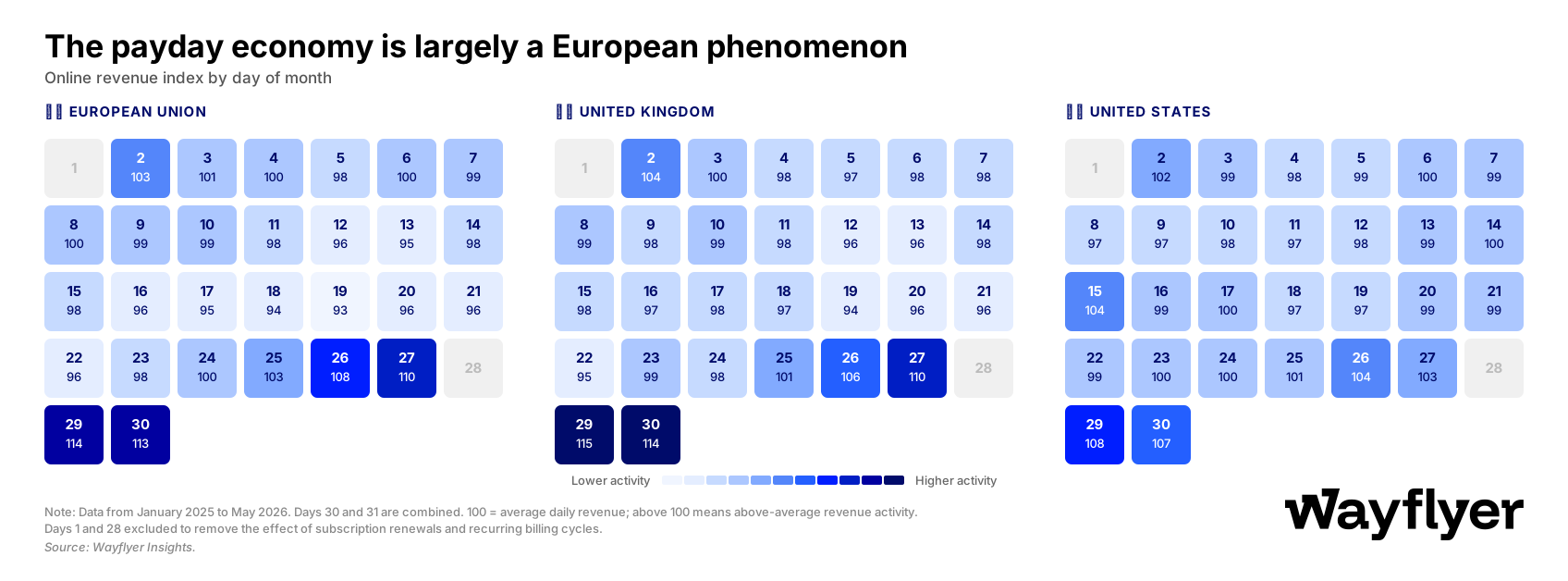
Two things worth calling out in the pattern:
-
Europe's surge is a clear end-of-month payday window. The EU and UK both climb from around day 25, peaking at 114 to 115 at the end of the month. Between the weakest day and the strongest, European markets swing 21 index points, compared to the US's 11.
-
The US gets paid twice, and you can see both. A mild bump around the 15th (index 104) and a larger one at month-end (108) where Americans are paid bi-weekly, but neither comes close to European magnitudes. Twice-monthly pay is part of it: when purchasing power arrives more often, no single day becomes high-stakes (though it still influences spending). Wider access to credit is plausibly the other part. A consumer who reaches for a credit card doesn't need to wait for payday.
The EU and UK swing 21 index points between their weakest and strongest days of the month. The US swings 11.
The index measures relative timing, not how much people spend overall: an EU figure of 114 means 14% above that market's own average day, not that Europeans outspend Americans.
The takeaway is simple: in the EU and UK, payday is a buy-now event; in the US everyday is payday. If you sell into Europe, that month-end window is the highest-intent moment in your consumer calendar, and the mid-month trough might be the worst week to spend on acquisition.
Disclaimer
Wayflyer Insights are based on aggregated, anonymized data from our base and are provided for general informational purposes only. They are not industry benchmarks, investment advice, or guarantees of outcomes, and may not be representative of the broader market.